
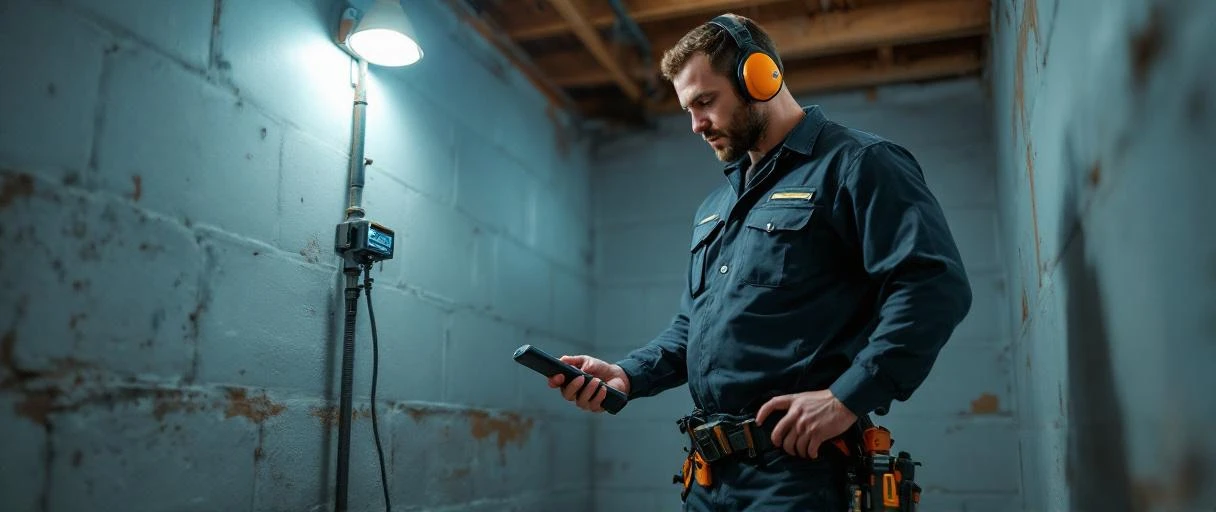
A leak you can see is a problem you can fix. A leak you can’t see is a problem that grows for weeks before damage shows up — sometimes silently running thousands of gallons through walls, slabs, or buried service lines while the homeowner sees only an unexplained water bill. Water Leak Detection Cincinnati OH dispatch handles hidden leak location, slab leak diagnosis, pinhole leak identification, polybutylene pre-failure inspection, and high-water-bill diagnostics. Acoustic detectors, thermal imaging cameras, moisture meters, and pressure isolation testing all ride on every leak-call truck.
Signs of a Hidden Leak Before You See Damage
Our broader scope across every emergency category — Emergency Plumber Cincinnati, our main page — covers licensing, pricing, and after-hours coverage details that apply to leak detection work as well. Hidden leak symptoms are subtle by definition, and most homeowners notice the secondary effects (high bill, mildew smell, damp spot) long before they identify the underlying cause.
A continuous toilet flapper leak runs roughly 200 gallons per day undetected — at GCWW rates, $30–$50/month in unnecessary water charges before any visible damage. A slab leak on the hot side typically produces a warm spot on the floor; a slab leak on the cold side produces a cold spot. Mildew or musty smell with no visible water indicates chronic small leaking somewhere upstream. Unusually green grass over a buried supply line route signals a service line leak below grade.
A leak severe enough to be audible at midnight needs same-night attention, and a round-the-clock plumber on rotating dispatch can run meter-test diagnostics before the loss adds up. Audible running water with all fixtures off is a fast confirmation — pressurized water escaping anywhere in the system makes sound that carries through structure.
Reading Your Cincinnati Water Bill for Leak Clues
GCWW residential rates currently average $5–$8 per 1,000 gallons depending on tier. A bill that jumps 30%+ over the same season last year, with no obvious household change, indicates a likely leak. Silent leaks of 200+ gallons/day add $30–$50/month before they’re visible elsewhere. Continuous toilet flapper leaks are the most common single cause; slab leaks and service line leaks are the next most common.
The water meter has a small triangular indicator dial that spins on any flow. With all fixtures shut off (including ice makers, irrigation, and water-using appliances), any movement of that dial confirms a leak somewhere in the pressurized supply system. The meter test is the fastest, cheapest first diagnostic before any acoustic or thermal work.
GCWW’s customer-side leak adjustment program provides a one-time bill credit for verified plumbing leaks repaired by a licensed contractor. We provide written documentation and repair invoices that support filing. Most homeowners don’t know to file for it after a slab leak repair.
How Acoustic and Thermal Equipment Locates Leaks
Acoustic leak detectors (Aquaphon A100, SubSurface LD-12) listen for the high-frequency hiss of pressurized water escaping a pinhole or failed fitting. The detector’s headset and ground sensor pick up sound transmitted through floor or wall structure. Trained operators triangulate the location by moving the sensor across the suspect area and watching signal intensity peak at the source.
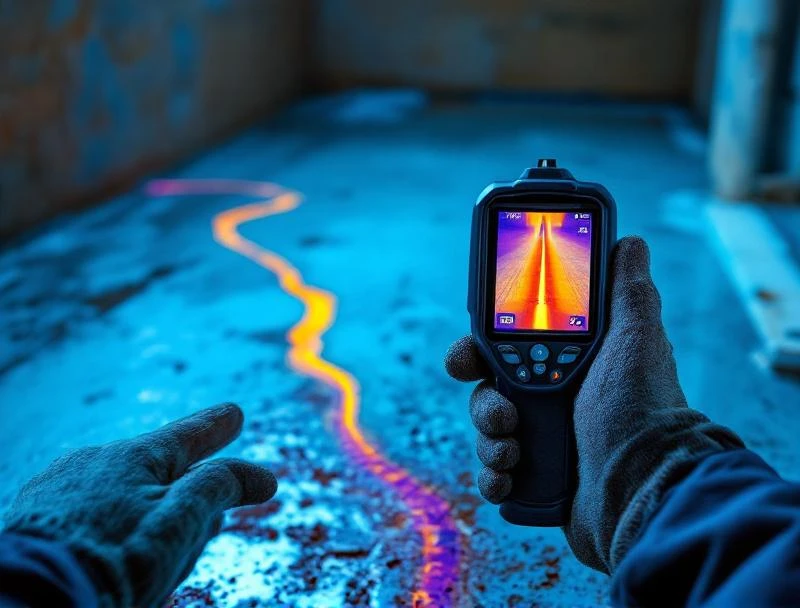
Thermal imaging cameras (Fluke TiS20+, FLIR E8 Pro, FLIR C5) show temperature differentials where water has wet adjacent surfaces. Hot-water slab leaks show as warm zones on the cool floor; the temperature difference is often 5–10°F. Cold-water slab leaks show as cool zones on the warmer floor — typically harder to read because the differential is smaller. Thermal imaging only locates slab leaks on hot-water lines; cold-line slab leaks require acoustic location with calibrated equipment, a distinction many handyman “leak detection” services miss.
Borescope inspection through a small access hole (often 1” or smaller) provides direct visual confirmation when needed. Moisture meters (pin and pinless) quantify wetness in walls and floors. Pressure isolation testing closes zone valves, pressurizes one section at a time, and watches for pressure drop — identifies which section holds the leak when acoustic and thermal aren’t conclusive on their own.
Slab Leaks in Cincinnati Homes — What Causes Them
Slab-on-grade housing in West Chester, Mason, Liberty Township, and Fairfield concentrates slab-leak risk. Type L copper rubbing against rebar in pre-1990 installs frequently develops pinhole leaks at the contact point — current code requires sleeving but pre-1990 installs often skipped it. Roughly 70% of slab leaks we locate are on the hot-water side because heat accelerates copper-to-rebar galvanic corrosion.
The Ohio Plumbing Code requires Type L copper (heavier wall) for under-slab supply lines. Pre-1985 Cincinnati slab homes frequently used Type M, which has 70–80% the wall thickness and pinhole-fails roughly 15–20 years earlier in chloraminated water. Once one slab leak appears, others on the same era line are likely within 2–5 years.
Repair options include rerouting the line above the slab (no slab cut, $1,500–$3,500) — typically the right call when accessible attic or wall routing is available. Slab cut and reseal ($2,500–$5,500) replaces the failed section in place but leaves the rest of the slab line intact. Whole-line replacement is the durable answer when multiple leaks have occurred.
Pinhole Leaks vs Pre-Burst Failures
A pinhole is the early stage of full burst failure on copper. The fan of mist or slow drip expands into a longitudinal split over months to years if left alone. Catching a pinhole at detection stage and repairing the joint or section is significantly cheaper than waiting for the full split to flood the basement. Once a pinhole opens into a full split, the work moves into Cincinnati burst pipe repair scope with cut-and-replace and proper pressure testing rather than continued detection.
Type M copper installed in Cincinnati between 1960 and 1985 has a typical service life of 50–70 years; pinhole leaks rise sharply after year 50. Cincinnati’s chloramine disinfection (since 2015) is gentler on rubber gaskets but slightly more aggressive on Type M copper than free chlorine, accelerating thin-wall failures. Pre-1986 copper installations may also contain lead solder; current code requires lead-free solder on any repair joint.
Polybutylene (gray plastic) supply pipe installed in Cincinnati area condos and townhouses 1978–1995 is class-action-settled defective. Most polybutylene systems are at or past end-of-life now. Insurance carriers may require full replacement after a single confirmed leak event. We surface polybutylene during any detection call and recommend whole-house repipe scope ($6,000–$15,000) when found.
Pricing for Leak Location Work in Hamilton County
Initial diagnostic: $250–$500. Full acoustic + thermal inspection: $400–$750. Slab leak location: $400–$850. Underground service line leak location: $350–$650. Borescope wall inspection: $200–$400. Pressure isolation testing: $250–$500. Tracer dye for tank leak: $150–$300.
Repair after detection (pinhole): $300–$700. Slab leak reroute (no slab cut): $1,500–$3,500. Slab leak cut and reseal: $2,500–$5,500. Polybutylene whole-house repipe: $6,000–$15,000. Service line replacement (curb to house): $3,500–$8,500.
Repair Options Once the Leak Is Found
Pinhole repair on accessible copper runs $300–$700 — sweat or ProPress section replacement on the affected joint or wall. Slab leak rerouting moves the supply above the slab through accessible attic, wall chase, or basement route. Slab cut and reseal opens the concrete over the leak point, replaces the failed section, and reseals — invasive but appropriate when reroute isn’t feasible.
Service line replacement (the buried supply between the curb stop and the house) is open-trench or pipe-burst scope. Trenchless pipe bursting pulls a new HDPE service line through the existing route while breaking the old line apart underground. Less yard disruption than full-trench replacement; comparable cost.
When the Source Turns Out to Be Elsewhere
A surprisingly common detection outcome: the moisture isn’t from a supply leak at all. When acoustic and thermal testing trace the moisture back to the water heater itself rather than a hidden supply line, the work shifts toward Cincinnati water heater repair scope with tank diagnosis or replacement. Tank-bottom corrosion produces water at the base that looks identical to a slab leak nearby.
A “mystery” bathroom floor leak frequently traces to a failed wax ring rather than a hidden supply line, and our toilet leak repair page covers wax ring replacement and flange diagnosis when that’s the actual source. Misdiagnosis is the enemy of efficient repair — proper detection prevents unnecessary slab cuts and wall openings on issues that turn out to be at-fixture mechanical fixes.
OCILB master plumber credential is required for permits on any repair requiring permit. License verification at license.ohio.gov shows status and expiration. The licence number appears on every invoice the plumber issues.
Need a Cincinnati Plumber Now?
Licensed · Bonded · Available 24/7
See Our Water Leak Detection Cincinnati OH Work in Cincinnati


Network Service Guarantees
- Written estimate before work begins
- All parts and labour warranted
- Licensed Ohio plumbers — verify at license.ohio.gov
- Same-day emergency service available 24/7
Pricing in Hamilton County
| Service | Cincinnati Range | Time Required |
|---|---|---|
| Initial leak detection diagnostic | $250–$500 | 1–2 hours |
| Acoustic + thermal full inspection | $400–$750 | 2–3 hours |
| Slab leak location | $400–$850 | 2–3 hours |
| Underground service line leak location | $350–$650 | 1–2 hours |
| Borescope wall inspection | $200–$400 | 1 hour |
| Pressure isolation testing | $250–$500 | 1–2 hours |
| Tracer dye for tank leak | $150–$300 | 30–60 min |
| Repair after detection (pinhole) | $300–$700 | 1–2 hours |
| Slab leak repair (reroute, no slab cut) | $1,500–$3,500 | 4–8 hours |
| Slab leak repair (slab cut and seal) | $2,500–$5,500 | 1–2 days |
| Polybutylene whole-house repipe | $6,000–$15,000 | 2–5 days |
| Service line replacement (curb to house) | $3,500–$8,500 | 1–2 days |
← Scroll to see more →
DIY vs Licensed Plumber
| Aspect | DIY Attempt | Licensed Plumber |
|---|---|---|
| Code compliance | Often fails inspection | Built to Ohio code |
| Permit | Not pulled | Cincinnati permit + inspection |
| Pressure test | Skipped | 100 PSI / 15 min per OPC 312 |
| Insurance | May void coverage | Licensed work covered |
| Warranty | No warranty | Parts and labour warranted |
| Recurrence rate | High (no diagnosis) | Low (root cause addressed) |
← Scroll to see more →
Get a Written Estimate Before Work Begins
Licensed Ohio plumbers — verify at license.ohio.gov
Without Professional Service
- Water damage continues spreading
- Larger repair bill comes later
- No permits pulled (insurance issues)
- Unlicensed work fails inspection
With a Licensed Network Plumber
- Fast emergency response time
- Proper repair to Ohio code
- Permits pulled when required
- Work guaranteed and warranted
Cincinnati-Specific Considerations
Cincinnati's housing stock is mixed — pre-1940 ~30%, 1940–1970 ~25%, post-1970 the balance. Each era has characteristic plumbing materials and failure modes. Pre-1940 homes in Northside, Price Hill, Walnut Hills, and Norwood frequently have galvanized supply and cast iron drain still in active service. Mid-century stock has Type M copper hitting end of life now. Suburban slab-on-grade in West Chester, Mason, Liberty Township concentrates slab-leak risk on copper-rebar contact points.
Greater Cincinnati Water Works delivers water at 120–150 mg/L hardness with chloramine disinfection (since 2015). The combination accelerates anode rod consumption, shortens Type M copper service life, and produces characteristic mineral buildup in drain lines. Cincinnati's 30 average freeze days per year drive winter freeze and burst events clustered between January and February. Polar vortex stretches push freeze risk into normally safe interior wall locations.
Cincinnati water and infrastructure
Ohio Licensing and Code Compliance
Every plumbing contractor in Ohio holds an OCILB master plumber licence (or works under one). The Ohio Construction Industry Licensing Board maintains a public lookup at license.ohio.gov — search by contractor name or licence number to verify status, expiration, and any disciplinary history. Cincinnati Department of Buildings handles permits inside city limits; Hamilton County Building Department covers unincorporated areas and townships.
The Ohio Plumbing Code (Ohio Administrative Code 4101:3) is the adopted IPC with Ohio amendments. Pressure test requirements, expansion tank mandates on closed systems with PRV or check valve, lead-free solder on all repair joints, and proper venting on every fixture all apply to emergency repair work the same as scheduled work. The Ohio Plumbing Code allows up to 72 hours to file emergency-work permits with Cincinnati Department of Buildings, giving overnight crews legal cover for after-the-fact filing.
License verification
Frequently Asked Questions
Related Services
Burst Pipe Repair Cincinnati OH
Need burst pipe repair in Cincinnati OH? Licensed plumbers in our network stop the leak, replace the section, and pressure-test the line. Call now.
Learn More →Emergency Water Heater Repair Cincinnati OH
Need emergency water heater repair in Cincinnati OH? We diagnose codes, leaks, and pilot failures on tank and tankless units. Call now.
Learn More →Emergency Toilet Repair Cincinnati OH
Need emergency toilet repair in Cincinnati OH? Licensed plumbers in our network fix overflows, leaks, and flush failures fast on every brand. Call now.
Learn More →